What we handle
Six things we get called out for, all out of the same yard on US 49.
Some of it is above the grass: the pump truck backing up the driveway, a technician walking the yard looking for a wet patch. Most of it is below the grass, which is why two calls to Seal Digging rarely look the same. Read on for how each one runs, or see how long we have been doing it.

Pump
Septic tank pumping
This is most of what the phone rings for: a tank that has not been pumped in a while, or an owner who genuinely cannot remember the last time it was. Our own vacuum trucks come out, we find the lids, and we pump the tank properly rather than just topping off what is easiest to reach. Tell us roughly how many people are on the system and when it was last done and we can usually tell you whether you are due or just worrying.
We also handle grease trap pump-outs on the same trucks. See grease trap work below.
Install
Septic system installation
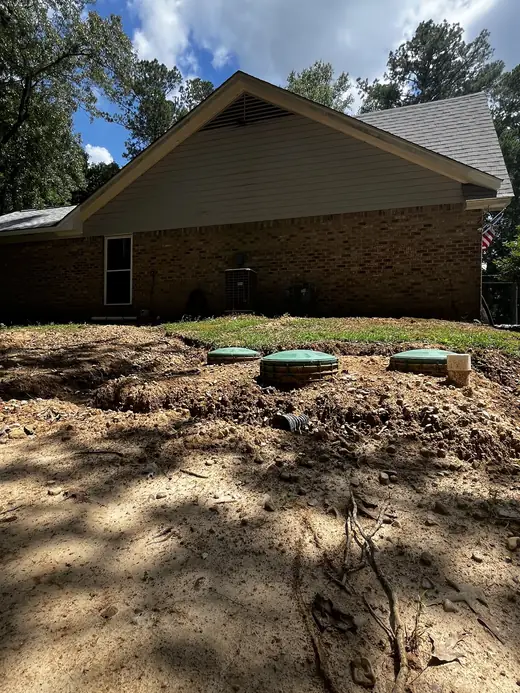
New builds and full replacements, from the excavation through to the risers set flush at grade and the fill dirt put back where it came from. If the old tank has failed outright, part of the conversation is whether a straightforward septic tank still makes sense or whether a treatment system is the better fit for the lot. On at least one job the homeowner’s own insurance ended up covering the install and the landscaping after a fallen tree limb took out an old tank lid, so it is worth asking your own policy before assuming the whole cost falls on you.
Every install we put in the ground is one we can be called back to service years later, which is most of what keeps this crew busy.

Treat
Wastewater treatment systems
We are an authorized dealer and service provider for Consolidated Treatment Systems, so Multi-Flo, Nayadic and Sybr-AER units are ones we install and then maintain rather than meet for the first time on a service call. That matters more than it sounds: a treatment plant is a mechanical system with a pump, an aerator and an alarm, not a passive tank, and the crew that opens the control panel already knows what that model is supposed to be doing.
If your property has no access to public sewer, a treatment plant is often what replaces a septic tank that has reached the end of its life. We can talk you through what changes above ground and below it before anything comes out.
The rest of the truck
Repairs, grease traps and commercial work.
These three come up less often than a routine pump-out, but they are the calls where knowing the system already matters most.
Repair
Spray heads, lines, pumps and alarms
Brown water at the sprinklers, an alarm that will not stop, slow toilets, a corner of the yard that never dries out. These are usually the treatment side of the system telling you something before it fails outright, and it is the call we get most after a routine pump-out. A technician inspects the lines, clears what needs clearing, and replaces a spray head or a pump if that turns out to be the fault.

Root intrusion is the other common cause. Roots find a tank long before a homeowner does, and clearing them is straightforward once the lid is off.
Trap
Grease traps
Installation and scheduled pump-outs for kitchens that cannot afford a back-up during service. Same trucks, same crews that run the septic side of the business.
Commercial
Commercial systems and car wash pump-outs
Lift stations, commercial wastewater systems and car wash pits. Larger volumes on the same equipment that handles a residential tank, and the same office that answers a homeowner’s call.
Not sure which of these you need?
Tell us what the yard is doing and we will tell you which of the six it usually is. Or read more about who has been doing this since 1968.